Why Your Delivery Route Zig-Zags
Typing stops into Google Maps in the order they arrive costs you time and fuel. The fix is a maths problem that was worked out decades ago.
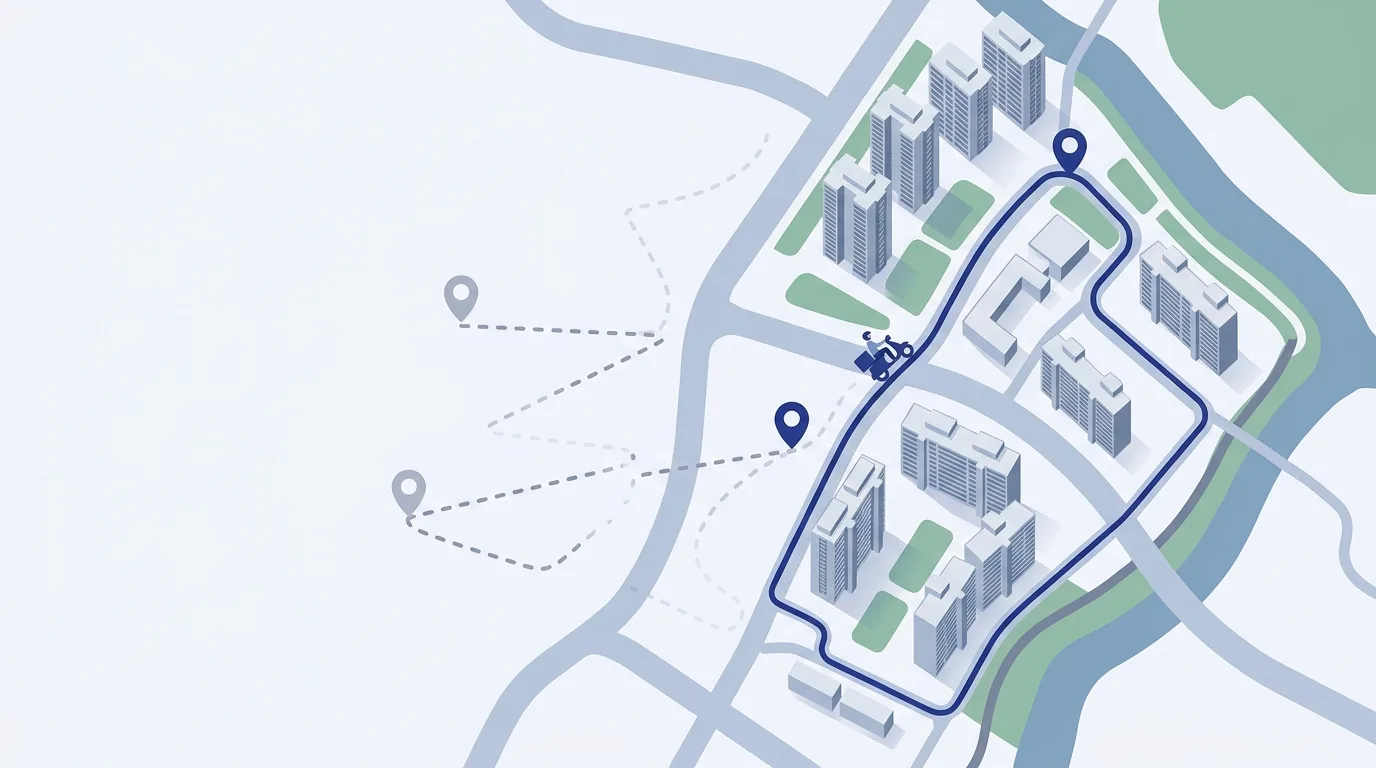
Picture a normal day. You've got four parcels to drop off around Punggol(a neighbourhood in Singapore) and one rider to deliver them. The orders came in at different times, so you open Google Maps, type the addresses in one by one, and set off.
It feels efficient. Usually, it isn't.
Google Maps follows your order. It doesn't fix it.
When you add several stops in the Google Maps app, it visits them in exactly the order you typed them. It finds a fast way from each stop to the next, but it never asks whether the stops themselves are in a sensible order.
Here are our four Punggol drop-offs, entered in the order they came in:

The route heads west to Sumang Walk, swings back east to Edgefield, then cuts back west to Punggol Central before turning south-east again.
Google Maps puts this at 28 minutes and 8.8 km, but that includes live traffic and a shortcut along Sentul Walk that Google itself flags as restricted or private. To compare fairly, we ran both stop orders on the same map, using public roads only:
The order you typed: 10.47 km, 29.8 minutes
Hikyaku's order (two stops swapped): 9.88 km, 28.2 minutes
Every time a route doubles back, you pay twice: once in fuel, and again in time your rider could have spent on the next delivery.

It only gets worse as you grow
With four stops, you might spot a better order yourself. But the number of possible orders grows frighteningly fast:
4 stops: 24 possible orders
10 stops: about 3.6 million
30 stops: more than there are grains of sand on Earth
Nobody can check that many by hand. On top of that, someone still has to key in every address, every day. It doesn't scale, and the cost lands on your riders and your fuel bill.
This problem was solved decades ago
Here's what most people don't know: finding the best order of stops is one of the most studied problems in computer science. It's called the Vehicle Routing Problem. George Dantzig and John Ramser first wrote about it in 1959, while planning petrol deliveries by truck.
Since then, researchers have built reliable methods that find excellent routes in seconds, even with hundreds of stops. For very large routes they may not promise the one perfect answer, but they get very close, very quickly.
You don't need "AI" for this
Plenty of delivery software now advertises "AI-powered" routing. It sounds impressive, but planning a route doesn't need a chatbot or a model trained on your data. It needs well-understood maths that has been put to work on real roads for decades.
That's good news for you. Proven methods are fast, well understood and easy to check: put the result on a map and you can see for yourself that it makes sense.
How Hikyaku does it
Hikyaku has this maths built in. Add your stops, tap optimise, and it works out the best order for you in one click. No shuffling addresses by hand.
On our four-stop run, that saves about 0.6 km and 1.6 minutes, roughly 5%. That's small for one run, but it applies to every run, every rider, every day. And the more stops you add, the more room there is to get the order wrong.
And because Hikyaku is open source, you can see exactly how your routes are worked out.